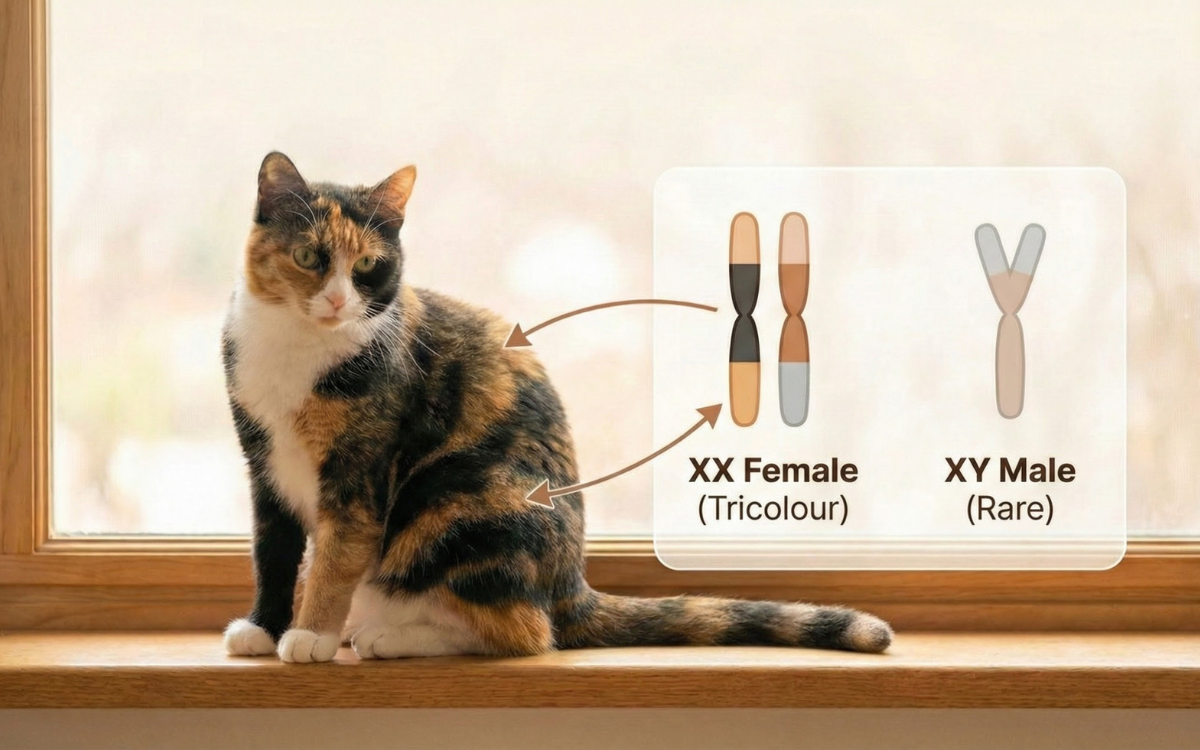
The image of a tricolour cat, a calico, is instantly recognisable. Its coat, a vibrant mosaic of black, orange, and white, is a phenomenon as common as it is mysterious to many. If you have ever wondered why 99.9% of these animals are female, the answer lies in one of the most fascinating curiosities of tricolour cat genetics.
Sex chromosomes and the gene that determines orange coat colour
To understand this enigma, we must dive into the fundamentals of cat coat colour genetics. In mammals, sex is determined by sex chromosomes: females have two X chromosomes (XX), and males have one X and one Y (XY).
The gene responsible for the orange colour (O, for Orange) or black (o, for non-Orange) of the coat is found exclusively on the X chromosome. Herein lies the key to tricolour colouration:
- Males (XY): They only have one X chromosome. Therefore, they can only express one sex-linked colour: they are orange (if they inherit X^O) or they are black/tabby (if they inherit X^o).
- Females (XX): Having two X chromosomes, they can inherit one copy of the orange gene (X^O) and one copy of the black gene (X^o). Only if they possess both versions (genotype X^O/X^o) will they be able to express both colours, resulting in the bicolour mosaic (black and orange/cream) necessary for tricolour colouration.
The white colour of the cat is due to another gene responsible for piebald, which results in white or unpigmented areas on the cat’s body.
X-chromosome inactivation
But how are these colours seen at the same time? This is where a biological process called X-chromosome inactivation (or Lyonization) comes into play, a central concept in cat colour genetics.
Because females have two X chromosomes, nature has developed a mechanism to deactivate one of them at random in each cell during embryonic development.
- If the cell deactivates X^O, the black allele (X^o) is expressed.
- If the cell deactivates X^o, the orange allele (X^O) is expressed.
This random process is what creates the pattern of orange and black patches characteristic of the calico or tortoiseshell cat. Each patch of colour on the cat comes from a population of cells where the same X chromosome was inactivated. You can better visualise this with a cat colour genetics diagram.
The 0.1% of tricolour males: A genetic abnormality
So, what about that 0.1% of tricolour males?
These males are a biological rarity with a genetic condition called Klinefelter Syndrome. Their chromosome set is XXY. Like females, they have two X chromosomes, which allows them to have the X^OX^oY genotype and, therefore, the tricolour coat.
However, due to this anomaly in chromosomal inheritance, almost all tricolour males are sterile. This teaches us how cat colour genetics work, demonstrating that reproducing the tricolour pattern is essentially impossible for a male.
The genetics of a cat’s coat colour not only determine the beauty of its mantle but also its sex. The curiosity of the tricolour cat is a perfect example of how the DNA code especially the FGF5 gene related to long hair that we explore on our website plays a crucial role in defining the diverse genetic traits of cats within their family lineage.