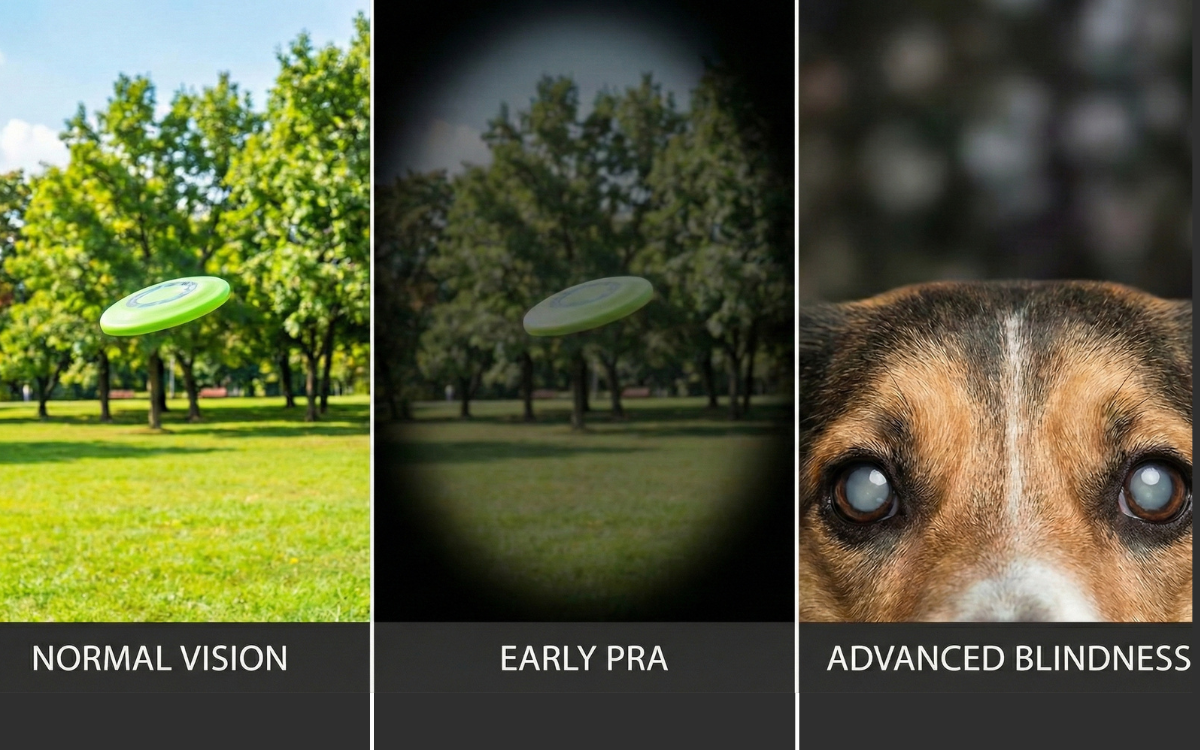
They say eyes are the mirror of the soul, and in the case of our pets, they are the tool with which they explore the world (just after their nose).
One of the most frequent causes of hereditary blindness is progressive retinal atrophy.
What is progressive retinal atrophy?
To understand the disease, we must first visualise the eye as a camera. The retina is the photographic film covering the back of the eye, responsible for capturing light and sending images to the brain via photoreceptor cells (rods for night vision and cones for day vision).
So, what is progressive retinal atrophy in dogs? (PRA). It is a group of degenerative diseases affecting these photoreceptor cells. Over time, these cells deteriorate and die, leading to gradual and irreversible vision loss.
Although the general term is the same, we can distinguish between progressive retinal atrophy in dogs and progressive retinal atrophy in cats. Although the final result is similar, the way it manifests may vary slightly between species.
Signs and symptoms: How do I know if my pet is losing their sight?
PRA is a silent disease at first. It does not cause pain, so the signs of progressive retinal atrophy are usually behavioural and visual.
Symptoms of progressive retinal atrophy in dogs
The symptoms of progressive atrophy usually follow a pattern. The first thing you will notice is night blindness (nyctalopia).
- Fear of the dark: Your dog may hesitate to enter dark rooms or go out into the garden at night.
- Dilated pupils: The eyes seem to shine more than normal (an increased greenish or yellowish reflection).
- Bumping into things: They start tripping over objects that are not in their usual place.
When observing symptoms of progressive retinal atrophy in dogs, you will see that over time visual difficulty transfers to the day as well, ending in total blindness.
Symptoms of progressive retinal atrophy in cats
Felines are masters of disguise. Symptoms of progressive retinal atrophy in cats can go unnoticed for a long time because they use their whiskers and hearing to compensate. However, you should be attentive to:
- Pupils very dilated even in light.
- Disorientation or reluctance to jump to usual high places.
- Changes in personality (they become more fearful).
Genetics and predisposition: Who does it affect?
This condition is almost always hereditary. This means genes play the main role.
Breeds of dogs with progressive retinal atrophy
Although any dog can suffer from it, there are certain breeds of dogs with progressive retinal atrophy that have a greater genetic predisposition, such as:
In cats, it is less common than in dogs, but breeds like the Abyssinian or Siamese have a documented incidence of feline progressive retinal atrophy.
Diagnosis: The importance of knowing
If you suspect something is wrong, veterinary confirmation is key. The specialist will perform an ophthalmological exam to look at the back of the eye.
However, definitive and early diagnosis is performed via a progressive retinal atrophy test.
- Electroretinography (ERG): Measures the electrical response of the retina.
- DNA tests: If you wonder about the simplest way, the answer lies in genetics. An analysis with a DNA test can detect if your dog is a carrier, affected, or free of the mutation even before symptoms appear.
Treatment and prevention: How can we prevent progressive retinal atrophy in dogs and cats?
Here we reach the most difficult part. Many owners desperately seek a treatment for progressive retinal atrophy in dogs or a treatment for progressive retinal atrophy in cats.
Currently, there is no definitive cure to reverse PRA. The damage to photoreceptors is irreversible. Some vets may recommend antioxidant supplements to try to slow the process, but lost vision is not recovered.
So, what can we do to help our pets?
Since there is no cure, the absolute key is the prevention of progressive retinal atrophy. And the only form of real prevention is responsible genetic selection.
- Genetic tests: If you are going to breed, it is fundamental to know what progressive retinal atrophy in dogs is at a genetic level. Crossing animals free of the mutation ensures the offspring do not develop the disease.
- Early knowledge: Knowing if your pet will develop the disease allows you to prepare and adapt your home before they lose their sight completely.
Although the diagnosis may be scary, remember: blindness is not the end of the world for them. Dogs and cats do not depend on sight as much as we do; their smell and hearing are their superpowers.
Knowing their genetics is not just science, it is the first step to caring for them better.