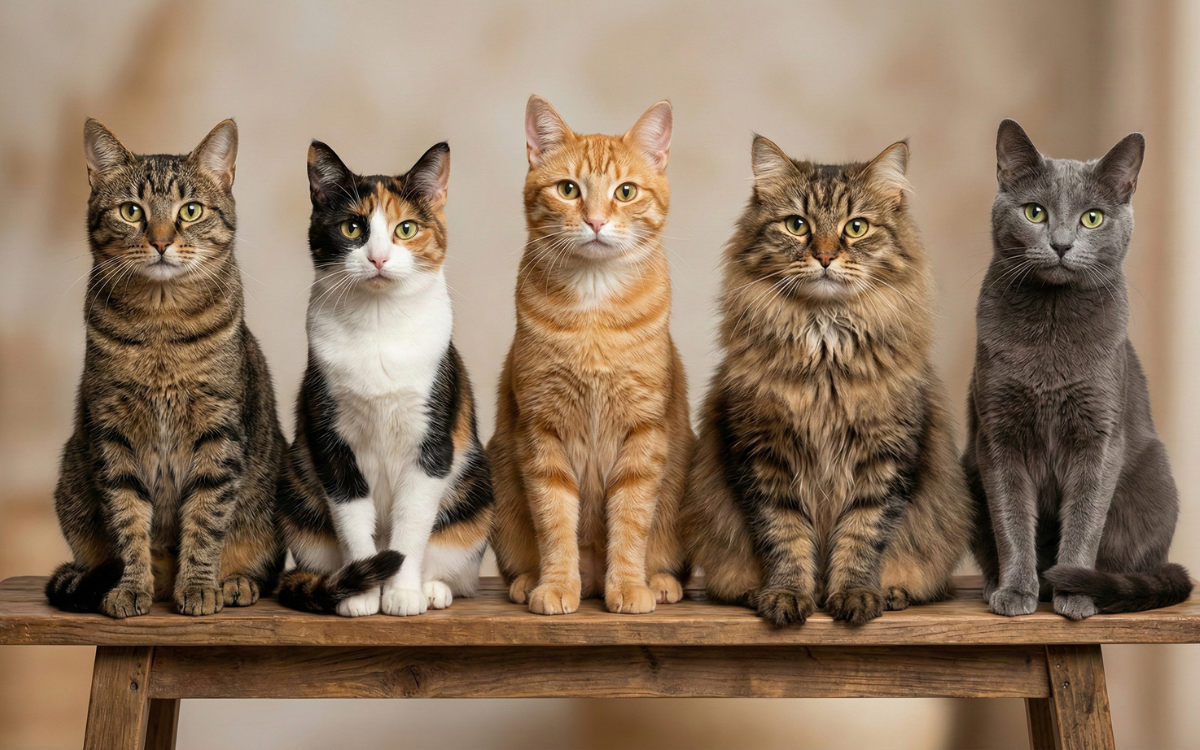
While purebreds follow strict standards, mixed-breed cats are unique, unrepeatable and, often, the longest-living and healthiest companions we can have.
What is a mixed-breed cat?
Although colloquially we sometimes hear people talk about the “mixed-breed” breed, the truth is that “mixed-breed” is not a breed in itself. A mixed-breed cat is one that does not possess a certified pedigree and whose ancestors come from the free mixing of different cats over time.
Technically, they are usually classified as European mixed-breed cats (or European Common Cat) when their morphology fits the standard of the Western domestic shorthair cat. However, their gene pool is so rich that every individual is a world of its own. Unlike dogs, where size differences are abysmal, most mixed-breed cats share a similar structure, but their coat varies infinitely.
Mixed-breed cats: characteristics and the health advantage
One of the most frequent questions we receive is: how long does a mixed-breed cat live? Here genetics plays in their favour. Thanks to a phenomenon known as “hybrid vigour” (or heterosis), mixed-breeds tend to have a lower predisposition to recessive hereditary diseases that often affect highly inbred pure breeds.
Although life expectancy depends on care and the environment, a healthy and well-cared-for mixed-breed cat usually lives between 15 and 20 years, often outliving their purebred relatives.
Among the most common characteristics of mixed-breed cats we find:
- Great intelligence: Fruit of natural selection and the survival on the streets of their ancestors.
- Robust immune system: Greater general resistance to common diseases.
- Balanced personality: They are usually adaptable and affectionate cats.
Types of mixed-breed cats: A rainbow of colours
The classification of these felines is usually done by their coat, which is one of the most visible and beautiful genetic expressions:
- The classic tabby mixed-breed cat It is the most ancestral pattern. The tabby mixed-breed cat carries in its genes the perfect camouflage of its wild ancestors. That “M” on the forehead is its distinctive hallmark.
- Orange mixed-breed cat and the genetics of sex The orange mixed-breed cat is special. The gene that determines the orange colour is linked to the X chromosome. That is why approximately 80% of orange cats are males. If you have an orange female, you have a genetic rarity!
- Tricolour mixed-breed cats Here the opposite occurs. Tricolour mixed-breed cats (calico or tortoiseshell) are almost exclusively females (99.9%), because they need two X chromosomes to express black and orange simultaneously.
- White mixed-breed cat and Grey mixed-breed cat The pure white mixed-breed cat can, on occasions, carry genes associated with deafness (especially if they have blue eyes), something important to watch out for. On the other hand, the grey mixed-breed cat (or solid blue) is highly appreciated for its elegance, reminding us of breeds like the Chartreux or the Russian Blue.
Mixed-breed or breed mix? Identifying traits
Sometimes, a mixed-breed presents physical characteristics so marked that we suspect one of their grandparents was purebred. It is here where the cat DNA test becomes fascinating to discover that “mix”:
- Long-haired mixed-breed cat: They often carry recessive genes from forest cat breeds or Persians that have remained hidden for generations until two carriers cross.
- Siamese mixed-breed cat: It is very common to see mixed-breeds with the colourpoint pattern (light body and dark extremities). This indicates inheritance of Siamese or Oriental genes in their lineage.
- Russian Blue mixed-breed cat: If your grey cat has a dense double-layer coat and emerald green eyes, it could have traces of this Russian breed in its DNA.
- Persian mixed-breed or Angora: If you observe a more robust bone structure, flat face (in the case of the cross with Persian) or a silky coat without an undercoat (typical of Angora influence), it is possible that there is a noble ancestor in their family tree.
Why analyse the DNA of a mixed-breed cat?
Knowing what a mixed-breed cat is goes beyond curiosity. Although they are mixed-breeds, they can carry genetic mutations relevant to their health or breed traits that explain their behaviour (such as the vocalisation of those with Siamese heritage).
At Koko Genetics we believe that every cat deserves to be understood from its deepest code. Knowing their genetic mix is not just naming their colours, it is giving them the best quality of life possible.