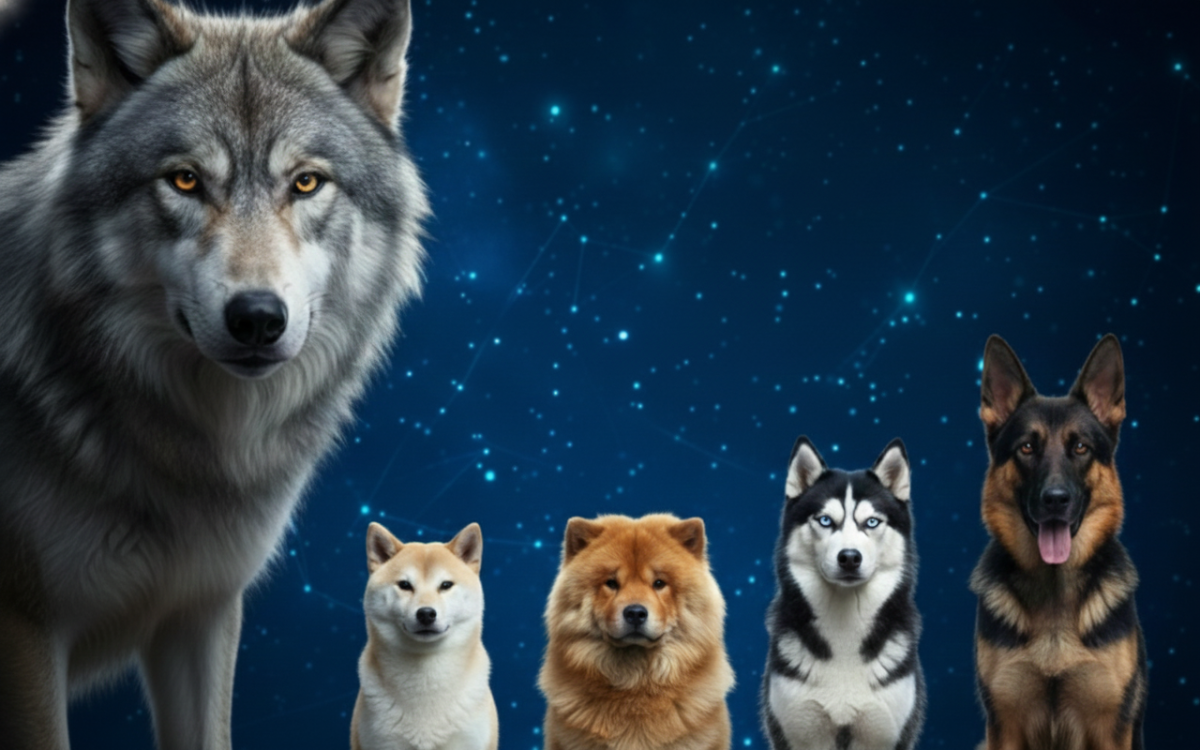
Does your dog’s penetrating gaze, that occasional howl or even its pack instinct… make you think of its wild ancestor? It is a question that intrigues many owners: can dog DNA tests really detect the presence of wolf in its genetics? As experts in canine genetics, let’s delve into this fascinating connection.
How much wolf DNA do dogs have?
It is an undeniable scientific fact: all domestic dogs (Canis lupus familiaris) share a common ancestor with gray wolves (Canis lupus). This means that, at a fundamental level, all dogs have wolf DNA. Domestication did not eliminate its wolf heritage, it simply shaped it over thousands of years. However, curiosity goes further. Many wonder: Which dog has the closest wolf DNA? or Which dog breed has the most similar wolf DNA?
Decoding DNA: Dog vs. Wolf
When we talk about dog and wolf DNA comparison, we are not referring to a “percentage” of wolf in the sense of a recent hybrid. Dog DNA tests, such as those from Koko Genetics, are designed to identify specific genetic markers found in different canine breeds and, yes, also to detect the presence of direct wolf DNA in cases of recent hybridisation.
A key aspect is understanding that there are breeds that are genetically closer to that wolf ancestor than others.
Breeds with the strongest wolf connection
DNA science has allowed us to identify which dog breed shares the most DNA with a wolf. Historically, there has been much debate about which dog has the most similar DNA to a wolf.
It has been suspected that the breeds genetically closest to the common ancestor could have a higher percentage of wolf, however, this is not entirely true. Those breeds with the highest percentage of wolf are those that are directly the result of the cross between dogs and wolves, such as the Czechoslovakian Wolfdog or the Saarloos Wolfdog. Furthermore, the Grand Anglo-French Tricolour Hound is a breed with an inexplicable percentage of wolf DNA, likely a consequence of undocumented crosses. Finally, the breeds closest to the common ancestor that share a small percentage of wolf are the following:
-
Shiba Inu
-
Akita Inu
These dog breeds are the ones that have the greatest amount of wolf DNA, this does not mean that they are wolves, but rather that their genetic code has preserved more characteristics of that common ancestor.
Wolf Hybrids: When the Line Blurs
This is where wolf detection becomes crucial. If you suspect that your dog could be a wolf hybrid, that is, a direct descendant of a cross between a domestic dog and a wolf in the last few generations, DNA tests are essential. Our analysis can identify specific markers that confirm the presence of direct wolf DNA, differentiating it from the common ancestral heritage to all dogs.
Why is it important to know?
Knowing if your dog has a wolf component is vital for several reasons:
-
Behaviour: Wolf hybrids may exhibit more unpredictable and wild behaviours that require specialised handling and socialisation.
-
Legalidad: In many regions, the possession of wolf hybrids is regulated or even prohibited.
-
Health: Nutritional and vaccination needs may differ.
At Koko Genetics, we pride ourselves on offering accurate tools to unveil the genetic history of your dog, from its breeds to the possible presence of wolf DNA in its recent family tree. Because every dog is unique, and its genetics are the key to understanding and caring for it better.