You look at your cat. He looks at you (with that mix of disdain and love that only they master). He has long hair, a strange spot on his ear and meows with a French accent. You ask yourself: “Is he a lost Norwegian Forest Cat or simply the king of the alley?”.
Until recently, the world of genetics seemed reserved only for dogs or for solving crimes in TV series. But the curiosity of the “Karens” and “Ames” of the world has brought a question to the table: do cat DNA tests work? The short answer is: yes.
The real science
So, how do cat DNA tests work? Here is the step-by-step:
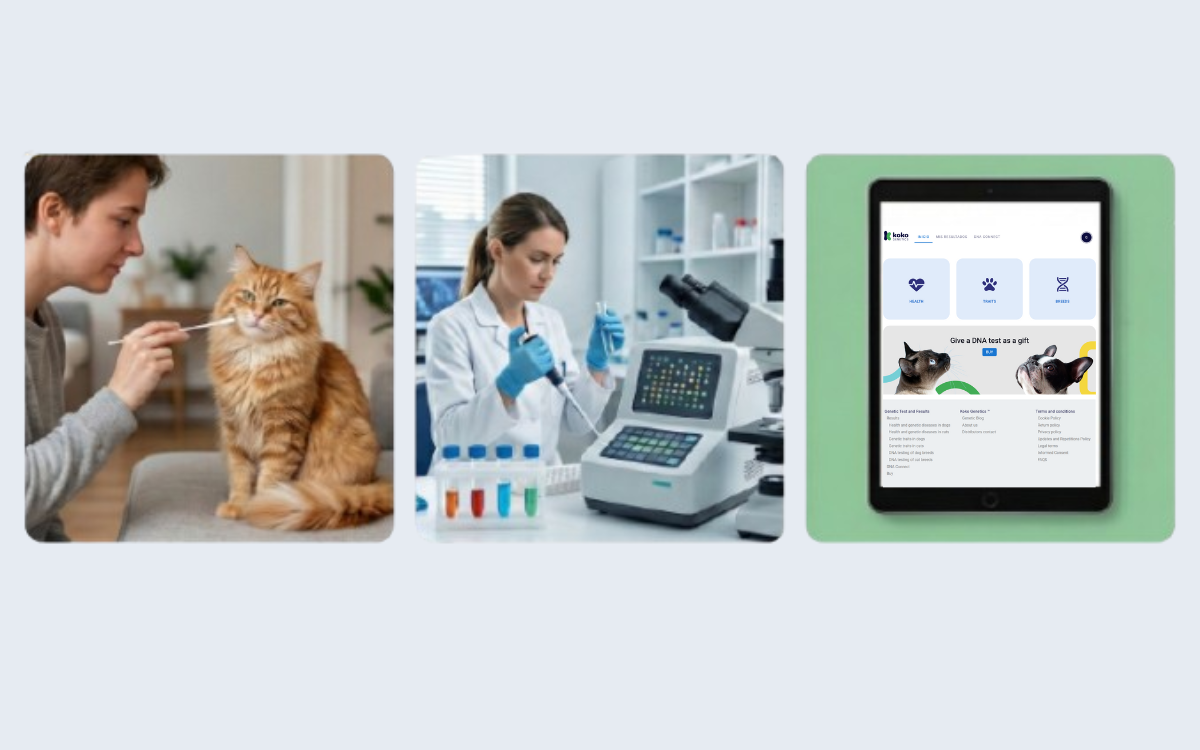
1. The Swab “Battle” (Sample collection) It all starts at home. The Koko Genetics kit includes buccal swabs (similar to cotton buds). Your mission, should you choose to accept it, is to gently rub the inside of your cat’s cheek.
- The objective: To collect epithelial cells. We are not looking for saliva per se, but the cells from the wall of his mouth that contain his entire instruction manual.
- The challenge: Convincing the cat. (Expert tip: do it when he is half asleep or have a treat to hand for the subsequent bribe).
2. Laboratory Once you send the sample back, our scientists spring into action.
- Extraction: We break down the cells to release the DNA located in the nucleus.
- Genotyping: We use microarray technology. Imagine an ultra-powerful reader that scans tens of thousands of specific markers in your cat’s genetic code. We look for specific “letters” that vary from one cat to another.
3. The comparison We take your cat’s information and compare it with our database of breeds and health markers. It’s not that your cat is 50% Siamese just because. It’s that his genetic markers match a specific pattern with the reference cats of that breed.
What does the Koko Genetics test tell you?
- Breeds and ancestry: Most cats are “polycats” (common domestic cats with no defined breed), but the test can reveal if that silky coat comes from a distant Persian relative or if that giant size is a Maine Coon inheritance.
- Genetic diseases: This is the serious part (and the most valuable). We can detect if your cat is a carrier of mutations associated with diseases such as Polycystic Kidney Disease (PKD) or Hypertrophic Cardiomyopathy. Knowing this in time can save his life, allowing you to take preventive measures with your vet.
- Physical traits: Why does he have curly hair? Why more toes than expected? His DNA has the answer.
Knowing how cat DNA tests work removes the fear of the unknown.
So, if you want to stop guessing and start understanding why your cat is so special, get the Koko Genetics cat DNA test.