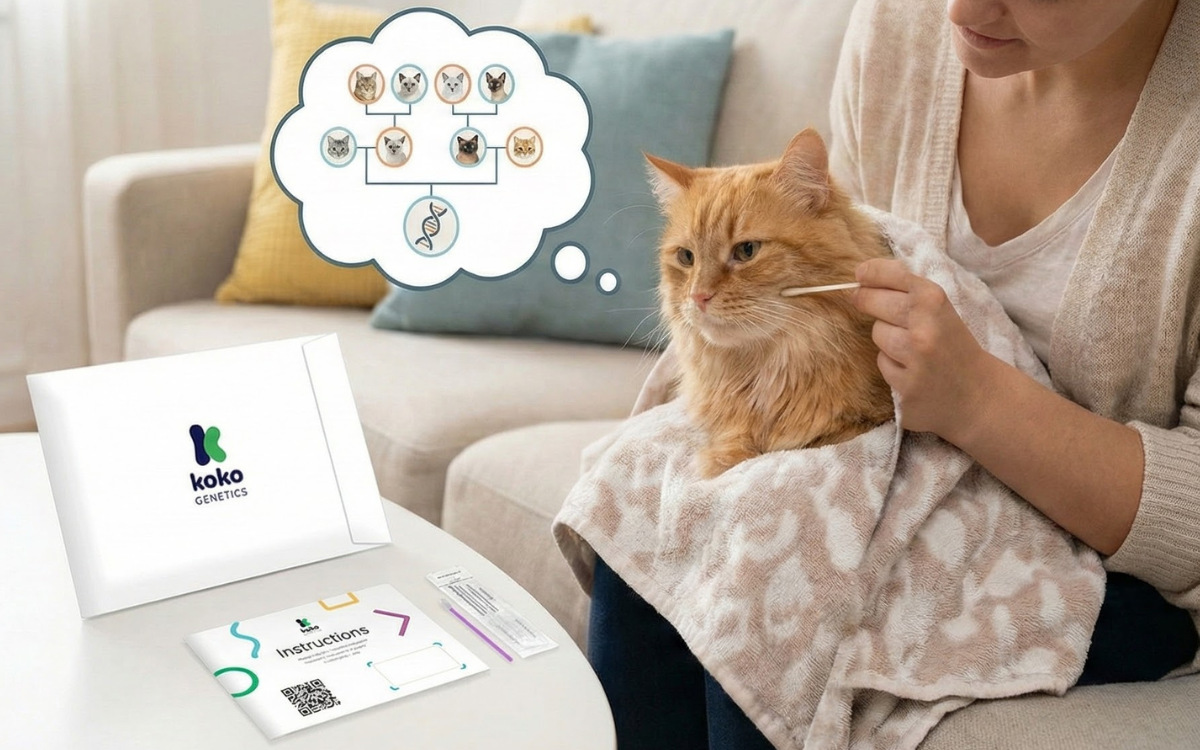
You look at your cat while they sleep in that impossible position and wonder: “Where do you come from, little furball?”.
Feline genetics has ceased to be a matter for secret laboratories and has reached your living room sofa. But of course, the big question arises: we know that cats are not exactly fans of cooperating.
How does a DNA test for cats work?
Do we need blood? A lock of hair?
None of that! Modern science is much kinder. The process is based on genotyping. All we need are the epithelial cells found in your cat’s cheeks. Yes, their saliva contains the complete map of their evolutionary history and lineage.
By analysing that sample, we compare their genetic markers with thousands of profiles in our database. This allows us to break down their family tree, identify breeds, physical traits and, most importantly, detect potential hereditary diseases.
How to perform a DNA test on a cat
If you have searched for “How to perform a DNA test on a cat”, you probably imagine a pitched battle. But if you follow these steps, it will be a piece of cake (or a piece of tuna).
Step 1: The strategic moment
Do not try to do it when your cat is in “hunting” mode or running down the corridor at 3 a.m. (the famous zoomies). Wait until they are half-asleep, relaxed and cuddly. Bribing with treats is perfectly legal and recommended in this jurisdiction.
Step 2: The “Burrito” technique (Optional but recommended)
If your cat is one of those who turn into liquid or get their claws out when they see something strange, wrap them gently in a towel or blanket, leaving only the head out. This gives you control and gives them a sense of security (and to you, physical integrity).
Step 3: Taking the sample
Koko Genetics cat DNA tests come with special swabs.
- Gently insert the swab into the cat’s mouth, between the gum and the cheek.
- There is no need to go deep, just at the side.
- Gently rub and rotate the swab for a few seconds. The idea is to collect cells, not just saliva, so make sure it touches the inner wall of the cheek.
It is likely that your cat will pull an offended face. This is normal. Apologise with a stroke.
Step 4: The drying
Koko Genetics kits for cats come equipped with a special active drying bag alongside its Rapidri swab. Immediately after taking the sample, place the swab directly inside this bag and seal it following the instructions. The bag’s technology will take care of drying the sample quickly and protecting it from bacteria until its arrival at the labouratory.
Step 5: Dispatching with the transport company Place the sample in the return envelope and send it to us. Done!
Beyond curiosity, knowing your cat’s DNA is an act of love. Understanding their lineage helps you understand why they act the way they do, but above all, it allows you to anticipate future health problems.
Performing the test is a matter of seconds; the information you obtain lasts for all their (seven) lives.